Delhi-NCR is already one of India’s most important real estate markets, but the region’s growth is increasingly being supported by something beyond traditional infrastructure projects: employment generation. The rapid expansion of Global Capability Centres, or GCCs, is emerging as an important factor that could influence commercial and residential property demand across the region.
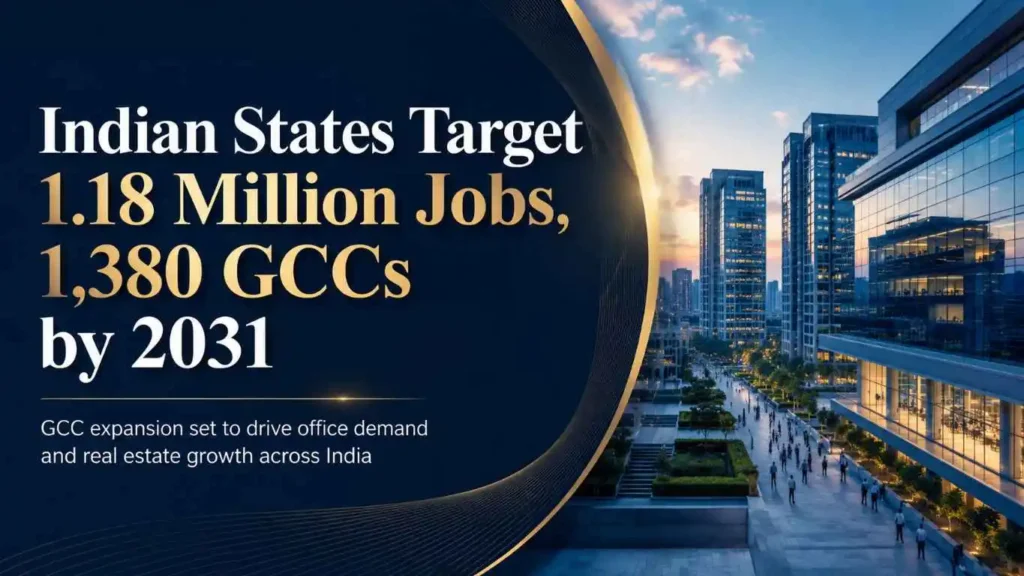
According to a recent CBRE South Asia report, Indian states are targeting around 1,380 new GCCs and nearly 1.18 million additional jobs by 2029-31. As companies expand their technology, finance, analytics, research and other high-value operations in India, the demand for office space is expected to increase.
For Delhi-NCR, this trend could create opportunities across established business hubs such as Noida, Greater Noida and Gurugram.
What Are Global Capability Centres?
A Global Capability Centre (GCC) is a dedicated centre established by a multinational company to manage important business functions from another location, such as India.
These centres can handle activities including:
Technology and software development
Artificial intelligence and data analytics
Finance and accounting
Research and development
Cybersecurity
Human resources
Business operations
Modern GCCs are no longer limited to traditional back-office functions. Many companies now use them for specialised and high-value operations.
This makes GCC expansion particularly important for cities with strong talent pools, infrastructure and connectivity.
Why GCCs Matter for Real Estate
The connection between GCCs and real estate is straightforward.
When a company establishes a new centre, it requires office space. When thousands of employees move into a city or business district, they need homes, transportation, restaurants, retail outlets and other services.
This creates a wider real estate ecosystem.
GCC expansion → New jobs → Office demand → Housing demand → Retail and infrastructure growth
This is why the increasing presence of GCCs can become a long-term demand driver for the Delhi-NCR real estate market.
Delhi-NCR Could Benefit From This Expansion
Delhi-NCR already has established commercial destinations and a large skilled workforce. Noida and Gurugram, in particular, have developed into major corporate and technology hubs.
The region’s connectivity is another advantage. Metro networks, expressways, airports and other infrastructure make major business districts more accessible for employees and companies.
As GCC activity increases, companies may look for locations that offer modern office buildings, connectivity and access to skilled professionals. This could support demand in established and emerging commercial corridors.
Impact on Noida and Greater Noida Real Estate
Noida
Noida has developed into an important commercial and IT destination with a growing office ecosystem. The city’s metro connectivity, expressways and proximity to Delhi make it attractive for businesses and employees.
More GCC activity could support demand for Grade A office spaces, commercial projects and nearby residential properties.
Greater Noida
Greater Noida could benefit from the expansion of the wider employment ecosystem. Its relatively large land availability and developing infrastructure provide opportunities for future commercial and residential development.
The Noida International Airport is another major infrastructure development that could strengthen the region’s long-term connectivity and investment potential.
Impact on Gurugram
Gurugram remains one of India’s strongest corporate markets and already houses offices of several global companies.
Continued GCC expansion could further support demand for premium office spaces in established business districts. Higher employment can also create demand for nearby residential properties, rental housing, retail and hospitality.
For investors, this makes employment-driven locations worth monitoring alongside traditional residential markets.
Commercial Real Estate Could See the First Impact
The immediate impact of GCC expansion is likely to be visible in the commercial office market.
More GCCs mean companies need larger and better-equipped workplaces. This can increase demand for Grade A buildings, flexible workspaces and strategically located commercial properties.
According to the CBRE report, GCCs leased more than 123 million sq. ft. of office space across India’s top nine cities between 2022 and H1 2026. Their share of total office leasing also increased significantly during this period.
This shows that GCCs are becoming an increasingly important part of India’s commercial real estate story.
Residential Demand Can Follow
The impact does not stop at office properties.
A growing employment base usually creates demand for housing close to major workplaces. Employees may prefer homes with convenient access to offices, metro stations, expressways and everyday amenities.
This can support both sales and rental demand in well-connected residential micro-markets.
For Delhi-NCR, locations close to major employment corridors could therefore benefit from the combination of job creation, infrastructure development and housing demand.
What This Means for Real Estate Investors
GCC growth provides another factor for investors to consider when evaluating Delhi-NCR properties.
Instead of looking only at current prices, investors can also examine:
Existing and upcoming employment hubs
Office space absorption
Metro and road connectivity
Infrastructure projects
Residential demand
Rental potential
Future commercial development
Areas that combine strong employment growth with improving connectivity may have better potential for sustained real estate demand.
Conclusion
The expansion of Global Capability Centres could become an important growth engine for Delhi-NCR real estate over the coming years. With Indian states targeting thousands of new GCCs and more than a million additional jobs, the impact could extend from office buildings to residential communities, retail spaces and supporting infrastructure.
For Noida, Greater Noida and Gurugram, the combination of employment growth, corporate expansion and improving connectivity makes the GCC trend worth watching. As more companies establish operations in the region, employment-driven real estate demand could play an increasingly important role in shaping the next phase of Delhi-NCR’s property market.